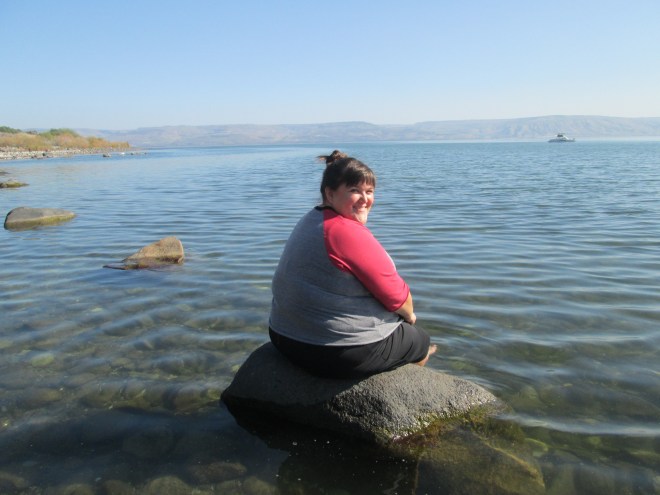
Last Sunday was Transfiguration Sunday. The transfiguration was said to have happened on Mount Tabor in Lower Galilee in what is now recognized as Northern Israel. In January of 2016 I was able to travel to Jordan, Palestine, and Israel with a group from my seminary.

And I had the opportunity to visit Mt Tabor.

The day I went we had an incredible tour guide. We met her that morning in Nazareth and she traveled with us for a few days to various holy sites.
I remember her name, but out of respect I’m not going to share it. Instead I will call her Aya. To tell her name and this story together is risky for her, so I will simply say that she is Palestinian by birth and Israeli by citizenship. I’ll tell you that she studied for years to become a tour guide, and that in Israel all tour guides must be licensed by the Israeli Ministry of Tourism.
When I met her I was struck by her composure. She was brilliant. She had an answer for every question. But she was guarded too. I felt it every time someone asked about the occupation and she answered the question with words that didn’t seem to be hers. I remembered then that sometimes composure is simply a thin cage of steel wrapped around a heart and a truth.
I was on the trip with my seminary for a class on homeland and displacement. In the few days that Aya was with us we had visited the church of the annunciation in Nazareth where the angel Gabriel was said to have visited Mary, which also happened to be Mary’s home.


We went to the Sea of Galilee where Jesus walked on water.


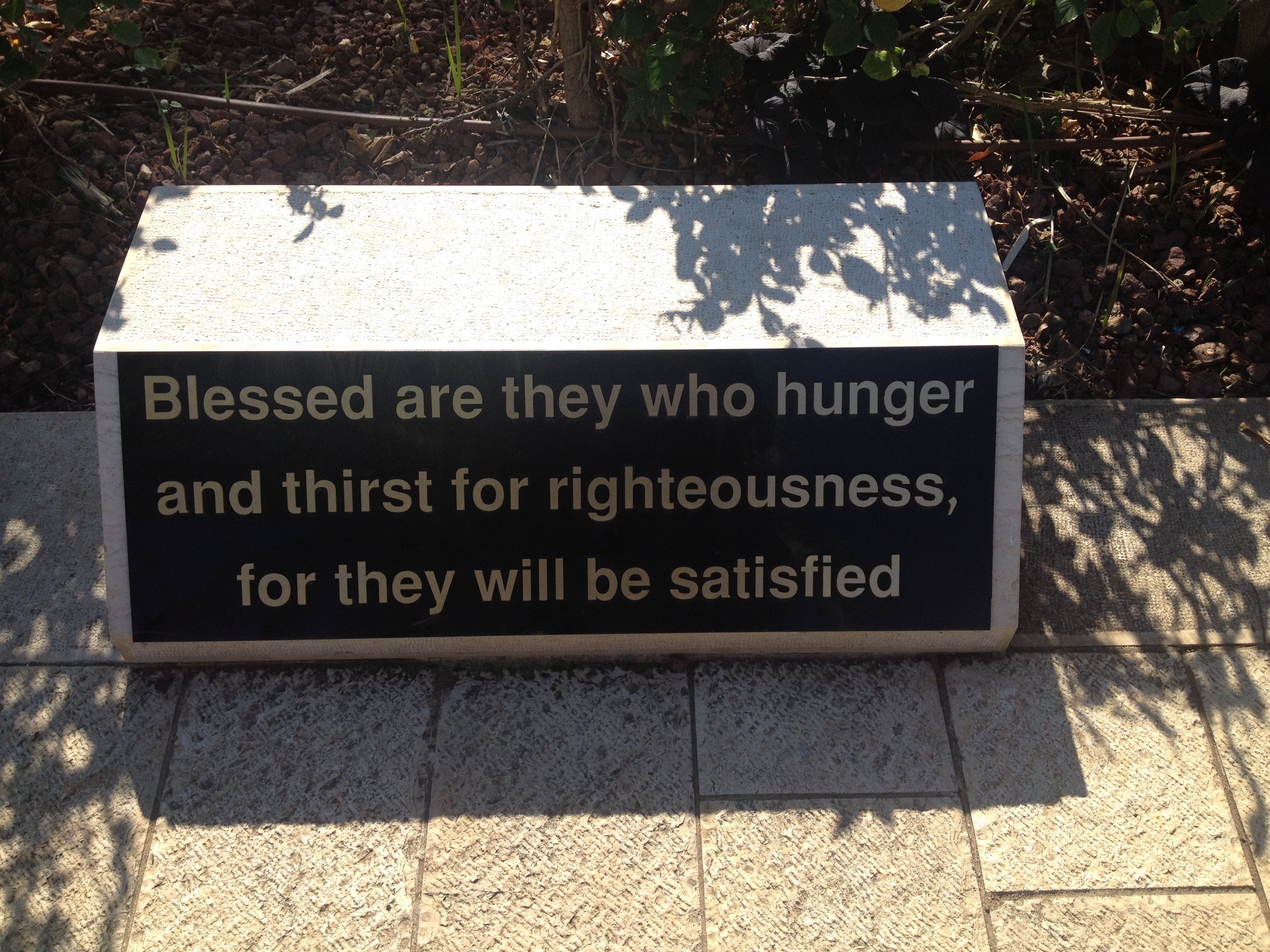
We stood in the spot where the Beatitudes were delivered.

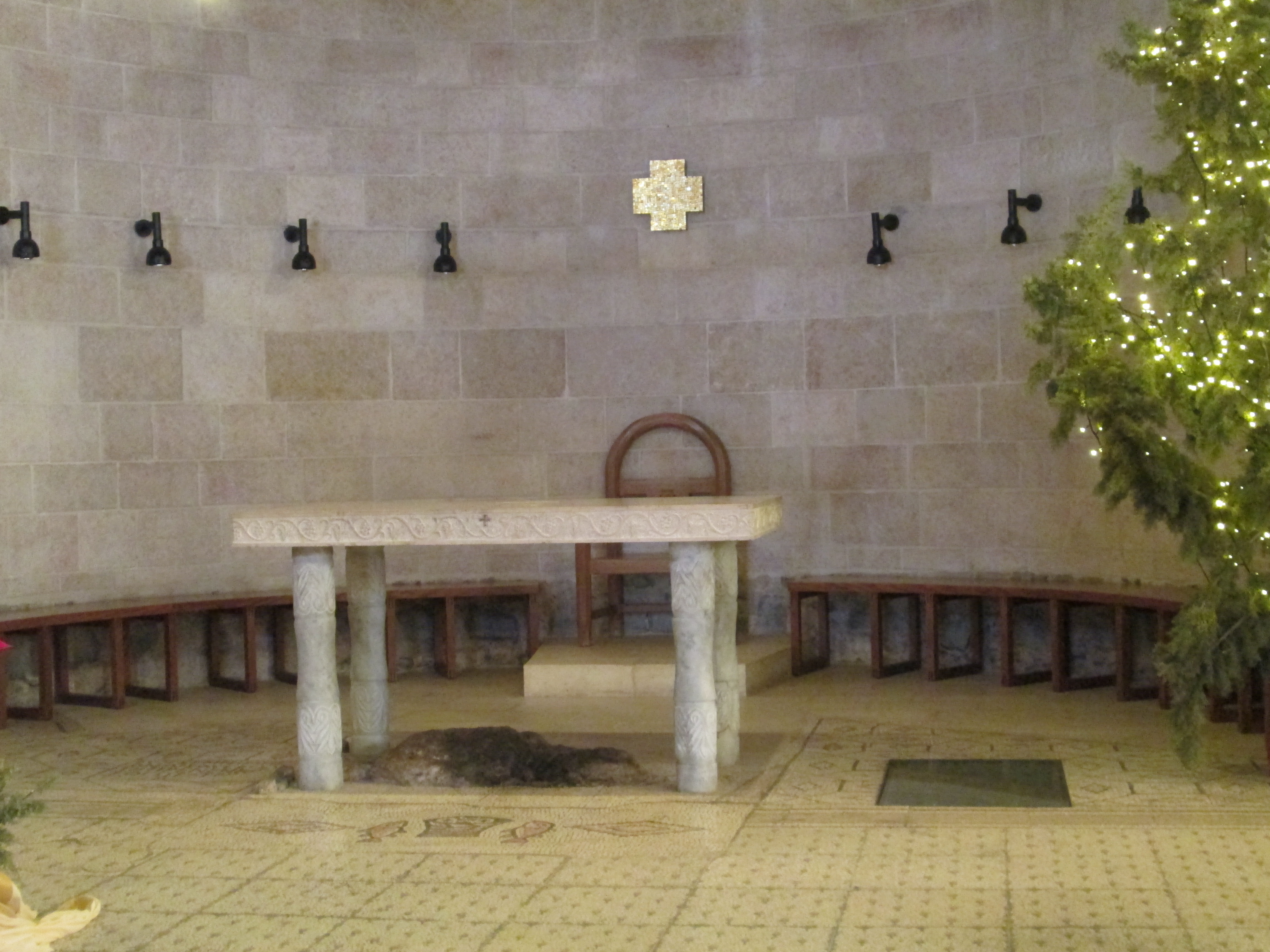
We saw the stone where Jesus multiplied loaves and fishes.
We even went to the location of the wedding where Jesus turned water into wine. And let me tell you, scripture says that Jesus turned “jars” of water into wine and these are NO mason jars. This is one of the jars. That wedding was a good time.

All of which is to say that we were in a land of miracles that I never understood to be real.
I didn’t grow up in the church. For me the bible was never literal. It was a collection of stories, it was a teaching tool. And in my desire to resist fundamentalism I had inadvertently removed the bible from its context entirely. Which is to say, that I took the bible out of Palestine and made it an abstraction of my moral imagination.
But places like Mt Tabor, where the Transfiguration is said to have taken place, are real. It is where Jesus took Peter, John, and James and revealed something true about himself. The place where they came to know their spiritual ancestors in a new way. I still don’t know if the story is real, but the mountain is. It’s 30 minutes from Nazareth and 11 miles from the Sea of Galilee. They are real too.
Aya scheduled our day so we would arrive at Mt Tabor at sunset.


A pinkish blue hung over the cathedral, rays of light stretching over what was once called rural Palestine.

Aya was different than she had been in the morning. Her breath seemed freer, her shoulders more at ease. We had earned some small amount of her trust.
Earlier that day she’d told us about being reported to the Ministry of Tourism. She’d been leading a tour at an outdoor site and someone asked a question. In her reply she included information about Palestinian history. Someone overheard her and called the Ministry of Tourism to report her. That information was not approved and so she was not allowed to share it. She was not allowed to speak her own history. She’d been formally reprimanded and almost lost her job.
Aya’s parents are Palestinian Christians who fled to Nazareth during the war in 1948. Like many, they thought they would be safe there. In fact most of the residents of Nazareth are Palestinian, internal refugees from the war, the Nakba, “the catastrophe”. About 30% of them are Christians.
I asked her if she was treated differently because she was Palestinian. “No”, she said, “I am not seen as Palestinian because to them Palestine does not exist.”
I was horrified. Then I remembered that a week before I had not treated places like Nazareth, Bethlehem, or Jericho like they were real either. Instead, I treated them like extensions of a metaphor. Imaginary settings for hymns and Sunday school stories.
American Christian nationalism, which I sought to avoid but still found myself caught in, is a violent distortion of memory. It is why I didn’t understand the connection between a whitewashed Jesus and the occupation of Palestine. It is how I could criticize the Israeli government without recognizing christian zionism in my own faith. It is how I could call myself a Christian without knowing Palestinians as my spiritual ancestors.
I was self righteous and short sighted. I thought myself a good leftist. But in my quest for political purity, I had missed the point entirely. And in doing so, I’d left so many people lonely for my solidarity.
As an American it is almost impossible to avoid Christian nationalism because America tries to claim Christianity as its own. I was traveling with a Seminary friend named Winford. He was a man in his 60s who was deeply committed to civil rights. I was sitting beside him when he asked one of our hosts when they’d converted to Christianity. Our host graciously smiled over their cup of tea while they explained that they’d never converted because their family could trace their faith back to the time of Christ. They had been there at the origin. Both Winford and I were overcome with the shame of our assumptions. And it was then that I realized how deeply Christian nationalism had its hooks in me. In us.
Christian nationalism, it is preaching disfiguration and calling it transfiguration. And we have to learn the difference.
When we discuss transfiguration we often talk about a sort of transcendence. Becoming less earthly and more spiritual. As if Jesus weren’t always both.
In the story of the transfiguration there are some key elements, that are perhaps still metaphors. There is a mountain, Jesus, spiritual ancestors in Moses and Elijah, and the voice of God.
Jesus brought Peter, James, and John up the mountain to pray. Perhaps to be closer to God. And it is on that mountain that those disciples came to see Jesus for who he truly was. A bridge of sorts. A bridge between the teaching of our ancestors, the living, and the divine. On that mountain God claimed Jesus. Jesus, who did not look away from suffering. Jesus, who demanded justice for his people. Jesus, a human with divine vision. “Listen to this one”, God said.
God placed Jesus in a human context and we weren’t asked to ignore it. The context, concrete and layered, was part of the point. Things do not have to be ethereal to be sacred. That is the lie of dualism, which continues to prop up white christian nationalism today. There is divinity in the ordinary, in the dirt, in the water, in everything.
God is with us in the mess.
On October 7th, and every day that has followed, my heart has broken. The devastation, the horror, the loss, the fear, the uncertainty, the looming response.
There’s so much mess. So many layers. So much to say. And absolutely no words.
I was gripped by grief, knowing that so many were about to suffer without the care or justice they deserved. Both Palestinian and Israeli.
The day after we’d visited Mt Tabor we went to Jerusalem. It was a different chapter of our trip. When we were in Nazareth it was easier to ignore political context, which is to say- it was easier to ignore the occupation.
It was different in Jerusalem.

We stayed in East Jerusalem, which is recognized by international law as part of the West Bank and a Palestinian territory, but is separated from the rest of the West Bank by a wall with a tedious and dangerous checkpoint, built by the same people who built the wall on our southern border.

With our American passports we were able to visit the other side of the wall, where we visited Bethlehem…

Ramallah…
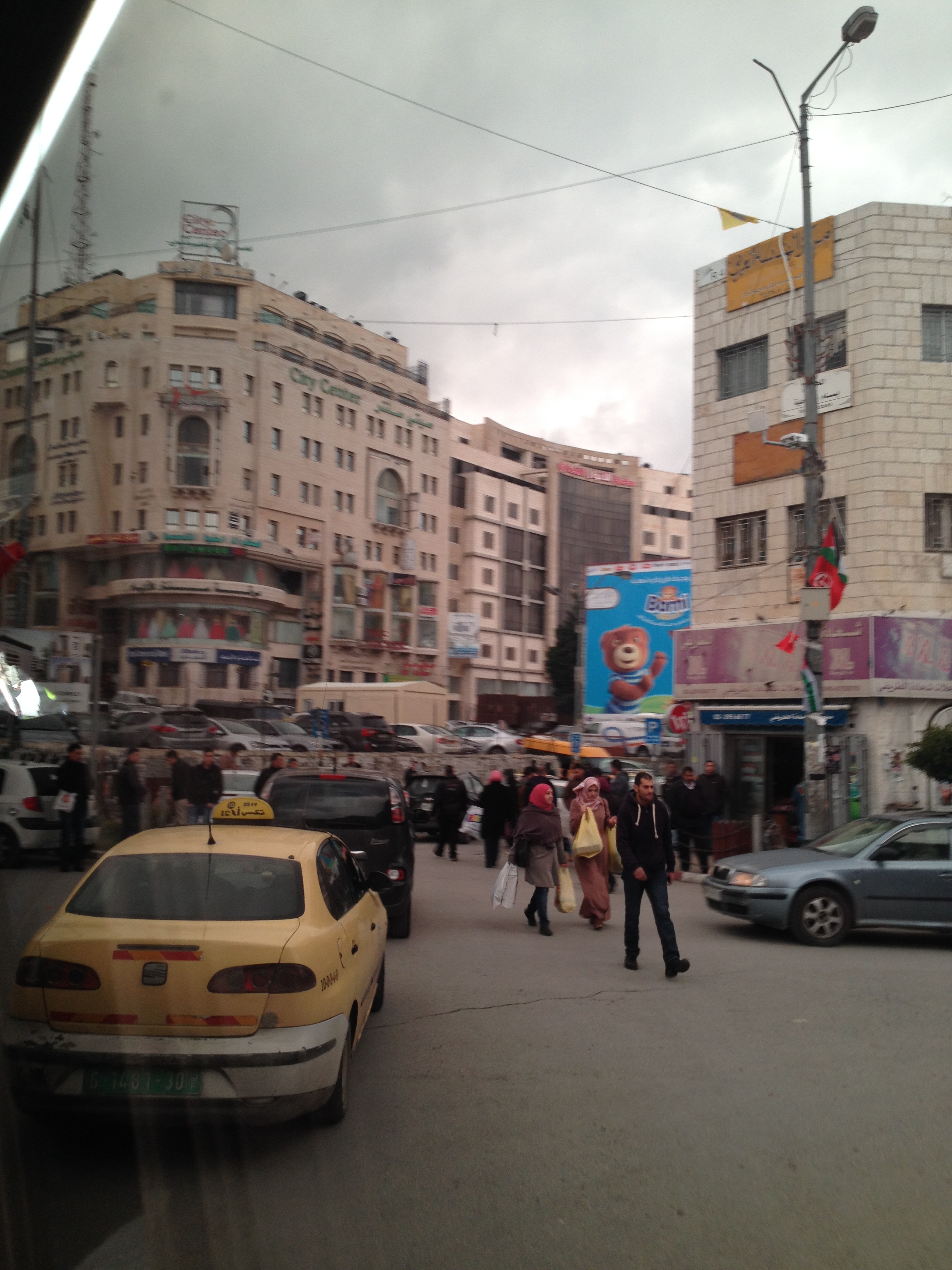
and the Jalazoune Refugee Camp.


It is a week that transformed my understanding of my faith, my values, and my politics. It made the context of Christ, of the origin of Christianity, unavoidable for me.
Before going to the West Bank I’d frequently reminded others that Jesus was a Palestinian Jew. But I didn’t feel the depth of what that meant. I didn’t understand the implications of that truth. It was virtue signaling instead of solidarity.
I treated the Roman Empire the same way I’d treated Nazareth, like an imaginary piece of a story. I never allowed the occupation that Jesus lived under to become real to me. Instead I used it as a literary device. A reminder that God was on the side of the oppressed, while somehow simultaneously ignoring the historical reality of their oppression. I used the Roman Empire and Jesus like characters in a book of morality that existed for my own spiritual and political formation. I was the center of the story. Not Jesus.
My time in the West Bank forced me to confront the complexity and intricacy of occupation. How it weaves into every aspect of life, every choice a people can make.
I visited the Church of the Nativity, in Bethlehem, in the occupied West Bank where Jesus was born.

In the West Bank, license plates are coded. Yellow and black for Israeli and white and green for Palestinian.

This lets the army and police know who is allowed to drive on the road and who isn’t. More and more illegal Israeli settlements are being established in the West Bank and in order to ease travel for the settlers Israeli only roads have been created. Only those with a yellow license plate are allowed on those roads. This also allows Israeli’s to bypass the checkpoints that surround the West Bank while continuing to restrict the freedom of movement of Palestinians.

It also acts as a shield between the actions of the Israeli government and the understanding of Israeli citizens and settlers. Israeli citizens are not allowed to enter most of the West Bank, which naturally limits their understanding of the conditions that Palestinians are living in.
Before going on this trip I was talking to my friend Noah, who is both Israeli and anti-zionist. We’d met while we both lived in Oakland, CA. I made some insensitive comment, fueled by political self righteousness, about how all Israelis were complicit in the occupation. I expected them to quickly agree with me. Instead they smiled at me, grace in their eyes, and said it is more complicated than that. How can it be more complicated, I responded? They live less than a mile away from where all this is happening. How can they pretend not to know? Noah smiled at me again and said, how much do you know – really know – about what is happening in East Oakland, less than a mile from here?
I felt their point like a punch. Empire, occupation, sometimes hides in plain sight. And while I embraced the nuance of my own social context and responsibility, I treated Israeli citizens like a flat character, devoid of any nuance of their own.
To get on a high horse and lecture Israelis about occupation as a white, Christian, American, takes a special sort of nerve and forgetting. As if my ancestors didn’t colonize the land I’m standing on, as if that colonization doesn’t continue today, as if Christian’s aren’t responsible for the antisemitism that got us here in the first place.
As an American citizen, I am painfully aware of what it is like to have a government that does not represent my values. So perhaps, I should not assume that other governments represent the whole of their people. And while neither I, nor Israeli citizens, are relieved from an obligation to learn and act, we can all find comfort in knowing that wherever nationalism exists, wherever occupation exists, there also exists a resistance. That is true in both nations, as well as faiths, and, when put in proper context, it is what the story of Jesus can teach us.
On our last full day in Israel/Palestine we stayed in Jerusalem and met a representative from the Christian Embassy.

At the time it was the only Embassy located in Jerusalem. Because of the contested sovereignty of Jerusalem, almost all embassies are located in Tel Aviv. Donald Trump changed that by moving the US Embassy to Jerusalem during his term, recognizing Jerusalem as the capital of Israel and undermining both Palestinian sovereignty and international law. Both the Christian Embassy and Donald Trump’s decision to move the US embassy are rooted in an ideology called christian zionism.
Christian zionism believes Jewish people must return to the Holy Land in order to fulfill biblical prophecy and bring about the second coming of Christ. Christian zionism actually predates Jewish zionism and is a driving political force in the United States.
While supporting a mass Jewish migration to Palestine, christian zionism asserts a parallel idea that the returnees ought to be encouraged to reject Judaism and convert to Christianity. They believe that when Jesus returns, those that haven’t converted will be killed.
The representative of the Christian Embassy that we met with shared that the embassy had supported over 150,000 Jewish people in returning to “the homeland”. He equated the occupation of Palestine to labor pains in the process of birthing salvation.
Christian zionists are often the first to say that critique of the Israeli government is anti semitic, while simultaneously pressuring Jews to convert or die in fulfillment of prophecy. It is christian zionism that is anti semitic. The Israeli government doesn’t represent Judaism, any more than the American government represents true Christianity.
The occupation of Palestine could not continue in the same way without the support of the U.S. and I do not believe that the U.S. would be as deeply invested were it not for the forces of christian zionism.
Which is to say, that as American Christians, we must not look away from the occupation or the current genocide in Gaza. We must not forget the context of our faith. We must reclaim our faith from the empire so that we can stand in faithful solidarity with Palestinians and Israelis.
I have been so deeply moved by the moral leadership of Jewish Voices for Peace and others who have organized beautiful actions calling for a Ceasefire in Gaza and a return of hostages, both Israeli and Palestinian.


They are so beautifully clear about the roots of their faith and the action it demands from them. I long for this same kind of clarity from Christians.
We are watching the rise of nationalism in the United States, in Israel, and across the globe. We have to care about what is happening in Gaza and Israel, because the forces that threaten their survival are the same forces that threaten ours.
White supremacy, occupation, erosion of democracy, war, genocide, anti semitism, attacks on reproductive freedom and queer and trans communities. These things are all connected. They are the tools of nationalism and the far right. They stem from the violent logic that some people are chosen, that God has favorites, and the rest of us simply stand between them and salvation.
It would be easy to simply say it’s complicated, and turn away. But the thing is… it isn’t. The people of Gaza, the people of Palestine, deserve to live and live well. They deserve freedom, the same as the hostages do. What is complicated, or perhaps just tiring and tricky, is finding a way to hold emotional space for the simultaneous devastation of genocide, anti semitism, and the crushing weight of nationalism. It feels impossible to offer the level of care and nuance to everyone in need. And I don’t have an answer for that. But I do know that our faith calls us to compassion, solidarity, and action. I do know that we have a God that sits with us in the mess.
Nationalism preaches disfiguration and calls it transfiguration. We have to learn the difference. The good news is that when we keep our faith, our scripture, our hymns in context, we have a road forward.
When we dropped Aya off at her office and prepared to part ways, she pulled me close, tears in her eyes, and whispered softly in my ear, “tell everyone what you have seen here. Do not let us be forgotten”. And I promised her I would. So I am trying to keep that promise, though I know I’m doing it imperfectly.
Because I know in my heart that, this time it’s all of us or none.
 Femminary